The Foundation: What is User Research and Why It’s Indispensable for Design Excellence
At its core, user research is the systematic investigation of target users and their requirements, aiming to add context and human perspective to the design process. It’s the disciplined pursuit of understanding who your users are, what they need, how they behave, and why they make certain decisions. For designers, especially those operating within fields like interior design, digital product development, or brand strategy, user research serves as the bedrock upon which truly impactful and user-centered solutions are built. It moves design from an art based purely on intuition to a science informed by empirical evidence.
Consider the expansive scope of modern design: from the intricate What Is UX Design And Why It Matters to the tangible experience of a physical space. In every scenario, the user’s interaction and perception are paramount. Without user research, design decisions risk being based on personal biases, outdated assumptions, or anecdotal evidence. This can lead to products or spaces that are difficult to use, fail to meet actual needs, or simply don’t resonate with their intended audience. The consequence? Wasted resources, frustrated users, and ultimately, a missed opportunity to create something truly exceptional.
The imperative for user research has only grown stronger in 2026. With increasing competition and user expectations, designers can no longer afford to guess. User research provides the clarity needed to:
- Validate Assumptions: Instead of assuming what users want, research provides concrete data to confirm or refute hypotheses.
- Identify Pain Points: It uncovers frustrations and challenges users face, providing clear opportunities for design intervention.
- Discover Unmet Needs: Often, users have needs they can’t articulate, which research can bring to light, leading to innovative solutions.
- Improve Usability: By observing users interacting with prototypes or existing designs, designers can pinpoint areas of confusion or difficulty.
- Inform Design Decisions: Research findings offer a solid rationale for design choices, moving conversations beyond subjective opinions.
- Measure Impact: Post-launch research helps evaluate the effectiveness of design changes and their impact on user satisfaction and business goals.
In essence, user research is the compass that guides the design journey. It ensures that every stroke of the brush, every line of code, and every piece of furniture placement is intentional, empathetic, and ultimately, effective. It elevates design from mere aesthetics to a profound understanding of human experience.
Diving Deep: Qualitative User Research Methods for Rich Insights

Qualitative user research methods are all about understanding the “why” behind user behaviors. These approaches delve into the subjective experiences, motivations, and perceptions of individuals, providing rich, descriptive data that quantitative methods often miss. They are invaluable for exploring complex issues, generating hypotheses, and gaining deep empathy for users. In the context of interior design, for example, qualitative research might uncover the emotional connection a client has to certain objects or the desired feeling they want their living space to evoke.
Interviews: Uncovering Personal Narratives
Interviews are one-on-one conversations with users, designed to explore their thoughts, feelings, and experiences in depth. They are highly flexible and allow researchers to adapt questions based on the interviewee’s responses.
- One-on-One Interviews: The most common form, offering a private setting for users to share their perspectives without peer influence. Ideal for sensitive topics or detailed exploration of individual user journeys.
- Structured Interviews: Follow a predetermined set of questions, ensuring consistency across participants. Useful when comparing responses across a larger qualitative sample.
- Semi-structured Interviews: Combine a core set of questions with the flexibility to probe deeper into interesting or unexpected responses. This is often the most effective approach, balancing consistency with the ability to discover new insights.
- Unstructured Interviews: More like a casual conversation, guided by a broad topic rather than specific questions. Best for exploratory research where the goal is to uncover unknown aspects of user experience.
Best for: Understanding motivations, pain points, desires, and gathering detailed feedback on specific experiences.
Focus Groups: Harnessing Group Dynamics
Focus groups bring together a small group of users (typically 6-10) to discuss specific topics, products, or designs under the guidance of a moderator. The interaction between participants can stimulate a broader range of ideas and opinions than individual interviews.
- Advantages: Can generate lively discussions, reveal shared opinions, and highlight areas of consensus or disagreement. Useful for gauging initial reactions to concepts or exploring cultural nuances.
- Disadvantages: Susceptible to groupthink, dominant personalities, and participants may not always express their true opinions due to social pressure.
Best for: Exploring a range of opinions, brainstorming, or testing initial concepts in a social setting. In interior design, a focus group might discuss preferences for smart home features or sustainable materials.
Ethnographic Studies & Contextual Inquiry: Observing Users in Their Natural Habitat
These methods involve observing users in their natural environments (e.g., home, office, public spaces) as they go about their daily tasks. The goal is to understand behavior within its real-world context, often revealing discrepancies between what users say they do and what they actually do.
- Ethnographic Studies: Long-term, immersive observation, often involving the researcher living among or spending extensive time with the user group. Provides deep cultural and behavioral insights.
- Contextual Inquiry: A shorter, focused form of ethnography where the researcher observes users performing specific tasks in their natural environment, often asking questions as the tasks unfold. For instance, observing how someone organizes their kitchen or navigates a public building.
Best for: Uncovering unspoken needs, understanding complex workflows, and identifying environmental influences on user behavior.
Diary Studies: Tracking Experiences Over Time
Diary studies involve users documenting their activities, thoughts, and feelings over an extended period (days, weeks, or even months). Participants typically record entries in a journal, app, or through periodic check-ins.
- Advantages: Captures data in context as events happen, minimizes recall bias, and provides insights into fluctuating emotions or long-term behavioral patterns.
- Disadvantages: Requires motivated participants, data can be unstructured and time-consuming to analyze, and participants might forget to record entries consistently.
Best for: Understanding habits, routines, long-term emotional responses, and how a product or service integrates into daily life.
Usability Testing (Qualitative Aspect): Observing Interaction
While usability testing can yield quantitative metrics (task completion rates, time on task), its qualitative aspect involves observing users as they attempt to complete tasks with a product or prototype, noting their struggles, confusions, and verbalized thoughts. This “think-aloud” protocol is crucial.
- Moderated Usability Testing: A researcher facilitates the session, providing tasks and observing, asking follow-up questions in real-time.
- Unmoderated Usability Testing: Users complete tasks remotely, often with screen and audio recording, providing flexibility but less opportunity for real-time probing.
Best for: Identifying specific usability issues, understanding user mental models, and observing direct interaction with a design. This is fundamental for refining a digital product’s Information Architecture Explained, ensuring users can find what they need intuitively.
Broad Strokes: Quantitative User Research Methods for Measurable Data
Surveys & Questionnaires: Gathering Widespread Feedback
Surveys are structured sets of questions administered to a large sample of users. They are highly efficient for collecting a broad range of data from a diverse audience.
- Types of Questions: Can include multiple-choice, rating scales (e.g., Likert scale), demographic questions, and open-ended questions (though these are qualitative in nature, they can be part of a quantitative survey).
- Distribution: Online platforms, email, in-app prompts, or even in-person.
- Advantages: Cost-effective, can reach a large audience quickly, and data is relatively easy to analyze statistically.
- Disadvantages: Lack of depth compared to interviews, potential for misinterpretation of questions, and low response rates can bias results.
Best for: Measuring user satisfaction, preference, demographics, identifying common behaviors, and validating assumptions across a large user group.
A/B Testing (Split Testing): Comparing Alternatives
A/B testing involves presenting two or more versions (A and B) of a design element (e.g., a button, headline, layout) to different segments of users and measuring which version performs better against a specific metric (e.g., click-through rate, conversion rate, time on page).
- Hypothesis-Driven: Always starts with a hypothesis about which version will perform better and why.
- Controlled Experiment: Users are randomly assigned to see either version A or version B, ensuring statistical validity.
Best for: Optimizing specific design elements, validating design changes, and making data-driven decisions on small, incremental improvements. This is particularly useful in refining digital products and marketing materials.
Analytics: Understanding User Behavior at Scale
Analytics tools collect vast amounts of data on how users interact with websites, applications, or social media platforms. This data provides insights into user flows, popular content, drop-off points, and overall engagement.
- Web Analytics (e.g., Google Analytics): Tracks page views, bounce rates, session duration, traffic sources, conversion funnels, and user demographics. Essential for understanding website performance and user journeys.
- App Analytics: Monitors app usage, feature adoption, retention rates, crash reports, and in-app purchase behavior.
- Social Media Analytics: Provides data on engagement rates, reach, impressions, follower growth, and demographic insights for posts and profiles. This data is indispensable for refining Social Media Graphics Design Guide strategies, revealing which visual content genuinely resonates with the audience.
Best for: Identifying trends, understanding user behavior at a macro level, pinpointing areas for improvement, and tracking key performance indicators (KPIs).
Card Sorting & Tree Testing: Optimizing Information Architecture
These methods are specifically designed to improve the organization and navigation of content, directly influencing the effectiveness of Information Architecture Explained. They help designers understand how users mentally categorize information.
- Card Sorting: Participants are given a set of “cards” (each representing a piece of content or a feature) and asked to group them in a way that makes sense to them, and then label these groups. This reveals users’ mental models for information organization.
- Open Card Sort: Users create their own categories and labels.
- Closed Card Sort: Users sort cards into predetermined categories.
- Tree Testing: Evaluates how easily users can find specific items within a proposed site structure (a “tree”). Participants are given tasks (e.g., “Find information about our return policy”) and asked to navigate through the tree without visual cues. This identifies navigation issues before visual design begins.
Best for: Designing intuitive navigation, categorizing content, and optimizing the structure of websites, apps, or even physical signage.
Eye-Tracking: Visual Attention and Engagement
Eye-tracking technology records where users look on a screen or in a physical space, how long they fixate on certain elements, and their visual scan patterns. This provides objective data on visual attention and engagement.
- Heatmaps: Visual representations showing areas of high and low attention.
- Gaze Plots: Show the sequence and duration of a user’s eye movements.
Best for: Optimizing layout, placement of key information or calls to action, and assessing the visual hierarchy of a design. In interior design, this could inform where to place focal points or essential signage.
Hybrid Approaches: Blending Qualitative and Quantitative for Comprehensive Understanding

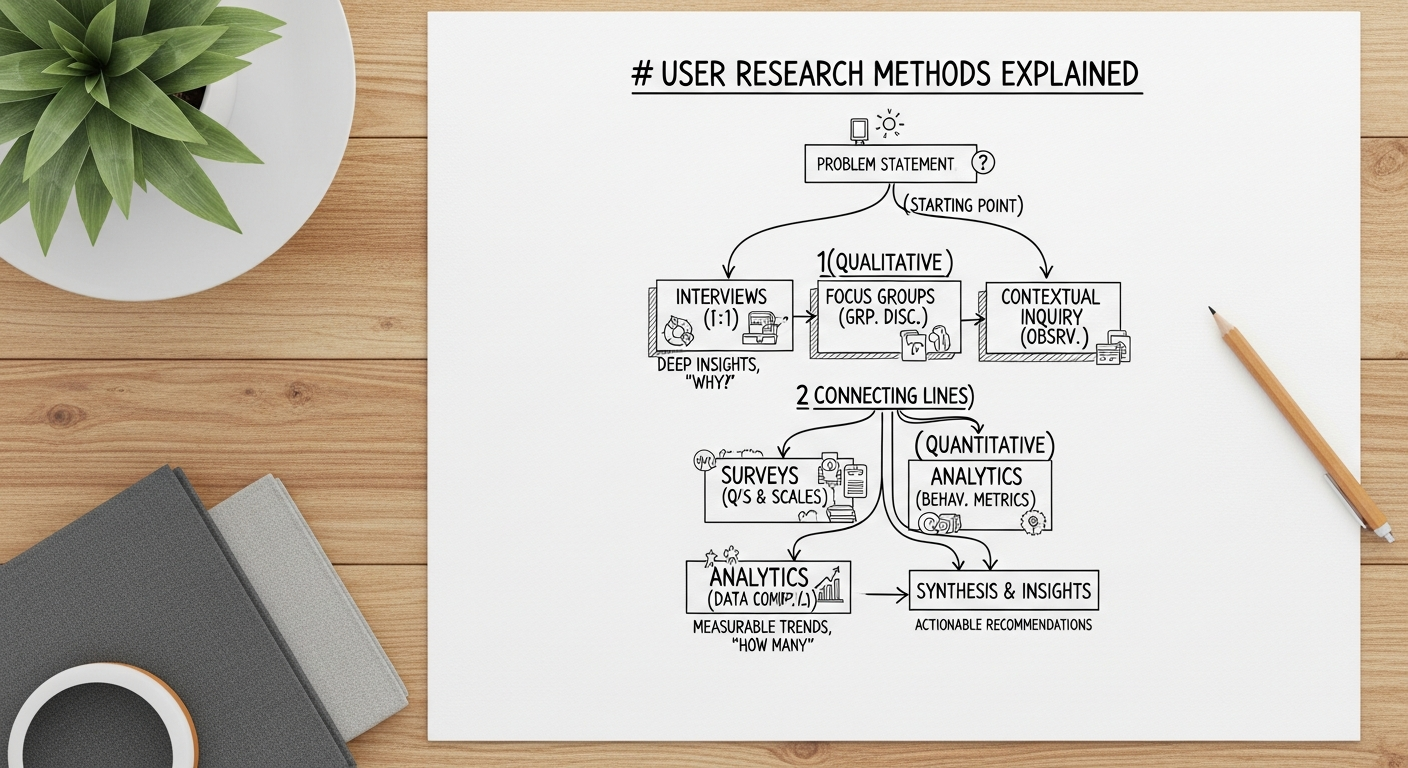
While qualitative and quantitative methods each offer distinct advantages, the most robust and insightful user research often comes from combining them. This mixed-methods approach, often referred to as triangulation, leverages the strengths of both paradigms to provide a more holistic and validated understanding of user needs and behaviors. In 2026, designers are increasingly embracing these hybrid strategies to paint a complete picture of their users.
The power of mixed methods lies in their ability to answer different facets of a research question. Quantitative data can tell you what is happening (e.g., “80% of users drop off at this stage”), while qualitative data can explain why it’s happening (e.g., “Users find this particular form confusing and frustrating”). By asking both “what” and “why,” researchers gain both statistical significance and rich contextual understanding.
Common Mixed-Methods Research Scenarios:
- Exploratory-Confirmatory:
- Start with Qualitative: Conduct interviews or ethnographic studies to explore a problem space, generate hypotheses, and uncover unknown user needs. For instance, in interior design, initial interviews might reveal a strong desire for adaptable living spaces.
- Follow with Quantitative: Design a survey or A/B test to validate these hypotheses across a larger user population. For example, a survey could quantify how many users prioritize modular furniture or multi-functional rooms.
- Quantitative-Qualitative Deep Dive:
- Start with Quantitative: Use analytics or surveys to identify trends, patterns, or problematic areas. For example, website analytics might show a high bounce rate on a specific product page.
- Follow with Qualitative: Conduct usability testing or interviews with users who exhibited those behaviors to understand the underlying reasons. Why are users leaving that product page? Is the Information Architecture Explained poorly, or are the images not compelling enough?
- Concurrent Mixed Methods:
- Collecting qualitative and quantitative data simultaneously and then integrating the findings during analysis. For instance, conducting usability testing while also tracking task completion rates and time-on-task. The qualitative observations help interpret the quantitative metrics.
By blending these approaches, designers can achieve a level of insight that neither method could provide alone. This not only leads to more informed design decisions but also strengthens the credibility of research findings. When presenting findings, having both compelling user stories (qualitative) and supporting statistical data (quantitative) makes a much more persuasive case for design changes or new initiatives.
For creative professionals, this means an interior designer might use surveys to understand broad aesthetic preferences (quantitative) and then conduct in-depth client interviews to understand the emotional significance of a space (qualitative). A marketer developing a Social Media Graphics Design Guide might analyze engagement metrics (quantitative) to see which posts perform best, then use focus groups (qualitative) to understand why those specific visuals resonate with their audience.
Embracing hybrid approaches ensures that your user research is not only comprehensive but also deeply actionable, turning raw data into powerful design insights.
Planning Your Research: Key Steps to a Successful Study in 2026
Effective user research isn’t just about selecting the right method; it’s about meticulous planning and execution. A well-structured research plan ensures that your efforts are focused, efficient, and yield meaningful results. In 2026, with an abundance of tools and a heightened awareness of ethical considerations, a robust planning phase is more crucial than ever.
1. Define Clear Research Objectives and Questions
Before you even think about methods, articulate what you want to learn. What problem are you trying to solve? What decisions will this research inform? Your objectives should be specific, measurable, achievable, relevant, and time-bound (SMART). Translate these objectives into concrete research questions that your chosen methods will answer.
- Example Objective: Understand why users abandon the checkout process on our e-commerce site.
- Example Research Questions: What pain points do users encounter during checkout? What information do they need but can’t find? What emotional factors influence their decision to complete or abandon a purchase?
2. Identify Your Target Users and Recruitment Strategy
Who are you trying to understand? Define your user segments based on demographics, behaviors, needs, and psychographics. Recruiting the right participants is paramount; researching the wrong users will lead to irrelevant insights. Develop a recruitment plan that outlines:
- Criteria: Specific characteristics participants must possess (e.g., uses competitor product, purchased a home in the last year, active on social media).
- Recruitment Channels: How will you find them? (e.g., existing customer lists, social media, recruitment agencies, in-app prompts).
- Incentives: What will you offer participants for their time? (e.g., gift cards, product discounts, cash).
3. Select Appropriate Research Methods
Based on your objectives and target users, choose the methods that will best answer your research questions. Consider whether you need qualitative depth, quantitative breadth, or a hybrid approach. Factors like budget, timeline, and available resources will also influence your selection. Remember that different questions often require different tools, as discussed in the previous sections on qualitative and quantitative methods.
4. Develop Your Research Protocol and Materials
This involves creating the actual tools for data collection:
- Interview Guides: List of questions and prompts.
- Survey Instruments: Carefully crafted questions, ensuring clarity and avoiding bias.
- Usability Test Scenarios/Tasks: Realistic tasks for users to perform.
- Stimulus Materials: Prototypes, mood boards, concept sketches, existing products, Social Media Graphics Design Guide examples, etc.
Pilot test your materials with a small group of internal colleagues or non-target users to iron out any kinks before going live.
5. Plan for Data Collection and Analysis
How will you collect and store your data? For interviews, will you record audio/video? For surveys, which platform will you use? Equally important is planning for analysis. For qualitative data, consider thematic analysis or affinity mapping. For quantitative data, plan for statistical analysis tools and methods.
6. Address Ethical Considerations and Obtain Consent
User research involves real people, and ethical conduct is non-negotiable. In 2026, privacy regulations and user awareness are high. Always:
- Obtain Informed Consent: Clearly explain the purpose of the research, what participation entails, how data will be used, and participants’ right to withdraw.
- Ensure Anonymity/Confidentiality: Protect participants’ identities and personal information.
- Minimize Harm: Avoid asking overly personal or sensitive questions unless absolutely necessary and handled with extreme care.
- Transparency: Be honest about your intentions.
A well-prepared consent form is a crucial part of this step.
7. Plan for Reporting and Dissemination of Findings
Research is only valuable if its insights are communicated effectively to stakeholders. Determine how you will present your findings (e.g., detailed report, executive summary, presentation, empathy maps, user personas, journey maps) and to whom. Consider incorporating actionable recommendations directly tied to your research objectives.
By investing time in this planning phase, you lay a solid groundwork for conducting impactful user research that truly informs and elevates your design outcomes.
Integrating Research into Your Design Workflow: From Insights to Impact
User research isn’t a standalone activity; it’s an intrinsic part of a continuous design process. For the insights gathered to truly make an impact, they must be seamlessly integrated into every stage of the design workflow, transforming raw data into tangible design solutions. This iterative cycle of research, design, and testing is what propels a project from good to exceptional, particularly crucial for navigating the complexities of design in 2026.
1. Research as the Starting Point: Discovery and Definition
Before any design work begins, research helps define the problem space and the user needs. This is where methods like interviews, ethnographic studies, and surveys are invaluable for understanding the core challenges and opportunities. For instance, in an interior design project, initial consultations and mood board exercises are essentially qualitative research, helping to define the client’s vision and lifestyle needs before concept development. This early-stage research informs the foundational decisions, preventing costly rework later on.
- Key Outputs: User personas, empathy maps, journey maps, problem statements, initial requirements. This foundational understanding ties directly into the importance of What Is UX Design And Why It Matters, as user research establishes the “user” in UX.
2. Research During Ideation and Concept Development
As ideas begin to form, research continues to play a vital role. Early concepts, sketches, or low-fidelity prototypes can be tested with users to gather initial feedback. Methods like concept testing, card sorting (for Information Architecture Explained), or early-stage usability testing can help validate design directions and identify potential pitfalls before significant investment is made. This ensures that the design concepts are not just aesthetically pleasing but also functional and user-centric.
- Key Outputs: Validated concepts, refined information architecture, prioritized features.
3. Research During Design and Prototyping: Iteration and Refinement
Once designs mature into higher-fidelity prototypes, more detailed usability testing becomes critical. Observing users interacting with a near-final product helps uncover specific usability issues, interaction flaws, and areas of confusion. A/B testing can be used to compare different design variations, such as different layouts for a product page or distinct calls-to-action in Social Media Graphics Design Guide. This iterative testing and refinement cycle is where designs truly get polished.
- Key Outputs: Usability reports, prioritized bug lists, refined visual designs, validated interaction flows.
4. Post-Launch Research: Monitoring and Optimization
The launch of a product or space is not the end of the research journey; it’s a new beginning. Post-launch research helps monitor real-world performance and gather feedback from actual users. Analytics tools track usage patterns and key metrics, while surveys and interviews can gather satisfaction data and identify new opportunities for improvement. This continuous monitoring allows for ongoing optimization and ensures the design remains relevant and effective over time.
- Key Outputs: Performance dashboards, user satisfaction scores, identification of new features or improvements, strategic insights for future iterations.
Embedding a Research Mindset
For research to truly make an impact, it needs to be embraced by the entire design team and stakeholders. This means fostering a culture where:
- Empathy is Central: Everyone understands and advocates for the user.
- Decisions are Data-Driven: Opinions are backed by evidence.
- Iteration is Expected: Design is seen as an evolving solution, not a static endpoint.
- Communication is Key: Research findings are clearly articulated and made accessible to all relevant parties.
By weaving user research into the fabric of your design workflow, you transform it from a mere task into a powerful strategy that consistently delivers impactful, user-centered experiences, ensuring your creations thrive in the competitive landscape of 2026.
Frequently Asked Questions
Recommended Resources
For more on user research methods, see How To Get More Website Traffic Organically on Eamped.
Learn more about this topic in Best Vpn Services 2026 Comparison at Bookmark Sharer.