Updated March 2026. Welcome to the definitive web design visual design guide for mastering digital aesthetics and user experience in 2026 and beyond. In an ever-evolving digital landscape, creating impactful, user-centric, and visually stunning websites is more crucial than ever. This comprehensive pillar page from LayoutScene.com is meticulously crafted for aspiring designers, seasoned professionals looking to refresh their knowledge, and anyone passionate about crafting exceptional digital experiences.
We will journey through the core principles that underpin great web design, explore the intricacies of visual aesthetics, delve into modern layout techniques with CSS, equip you with the best design tools, and emphasize the paramount importance of accessibility. Prepare to elevate your understanding and practical skills, ensuring your designs are not only beautiful but also functional, inclusive, and future-proof. Let’s build the web of tomorrow, today.
TL;DR: This guide covers essential web design fundamentals, from color theory and typography to advanced CSS layouts, indispensable design tools, and the critical aspects of building accessible websites. Master these elements to create visually appealing, user-friendly, and inclusive digital experiences that stand out in 2026.
The Foundations of Good Web Design and Core Web Vitals
Good web design is much more than just making something look pretty; it is about solving problems, facilitating user journeys, and creating intuitive, engaging experiences. At its core, web design is a blend of art and science, requiring a deep understanding of human psychology, technological capabilities, and business objectives. The foundation of any successful website lies in a user-centric approach, prioritizing the needs and behaviors of the people who will interact with it. This means conducting thorough research, creating user personas, and mapping out user flows to ensure every design decision serves a purpose.
Key principles such as hierarchy, balance, contrast, and repetition are fundamental visual design concepts that translate directly into effective web design. Furthermore, understanding Gestalt principles—such as proximity, similarity, and closure—helps designers organize visual elements so users perceive them as a unified whole. Hierarchy guides the user’s eye through content, emphasizing important information. Balance creates a sense of stability and order, whether symmetrical or asymmetrical. Contrast helps differentiate elements and improve readability, while repetition fosters consistency and strengthens brand identity. The Nielsen Norman Group (NN/g), a leading authority in user experience, consistently highlights the importance of usability heuristics such as visibility of system status, match between system and the real world, and error prevention.
Furthermore, responsive design is no longer an optional feature but a mandatory requirement. With users accessing websites on an ever-growing array of devices, a website must seamlessly adapt to different screen sizes and orientations. A robust web design strategy also heavily considers performance, specifically Google’s Core Web Vitals. Slow loading times can significantly deter users and negatively impact search engine rankings. Designers must actively use tools like Lighthouse and PageSpeed Insights to monitor and optimize metrics such as Largest Contentful Paint (LCP) for loading speed, First Input Delay (FID) or Interaction to Next Paint (INP) for interactivity, and Cumulative Layout Shift (CLS) for visual stability. Optimizing images, minimizing code, and leveraging content delivery networks (CDNs) are crucial steps in delivering a fast and efficient website.
Types of Color Schemes and When to Apply Them

Color is one of the most powerful tools in a web designer’s arsenal, capable of evoking emotions, directing attention, and establishing brand identity. A solid understanding of color theory is indispensable for creating engaging and effective user interfaces. At its most basic, color theory revolves around the color wheel, which illustrates the relationships between primary, secondary, and tertiary colors. Understanding hues (the pure color), saturation (the intensity of the color), and value (how light or dark a color is) allows designers to manipulate color to achieve specific visual effects and communicate desired messages.
Beyond the technical aspects, color psychology plays a significant role in how users perceive a website. Different colors are associated with different emotions and concepts; for example, blue often conveys trust and professionalism, green suggests nature and growth, while red can signify urgency or passion. Strategic use of color can guide user behavior, highlight calls to action, and create a specific mood. Developing effective color schemes involves understanding principles like monochromatic (variations of a single hue), analogous (colors next to each other on the color wheel), complementary (colors opposite each other), and triadic (three colors evenly spaced on the color wheel). Each scheme offers a unique visual harmony and can be chosen based on the project’s goals and brand identity.
However, the beauty of color must always be balanced with the necessity of accessibility. For web designers, this means rigorously adhering to contrast ratios as specified by the Web Content Accessibility Guidelines (WCAG). WCAG 2.1 and 2.2 recommend specific contrast ratios for text and graphical elements to ensure readability for users with visual impairments. For example, normal text generally requires a contrast ratio of at least 4.5:1, while large text needs 3:1. Ignoring these guidelines can render a website unusable for a significant portion of the population. When you are ready to select and refine your colors, you will find immense value in our dedicated resource, which explores the Best Color Palette Tools for Designers, offering practical solutions for generating and testing your schemes.
How Do You Choose the Right Fonts for Web Design?
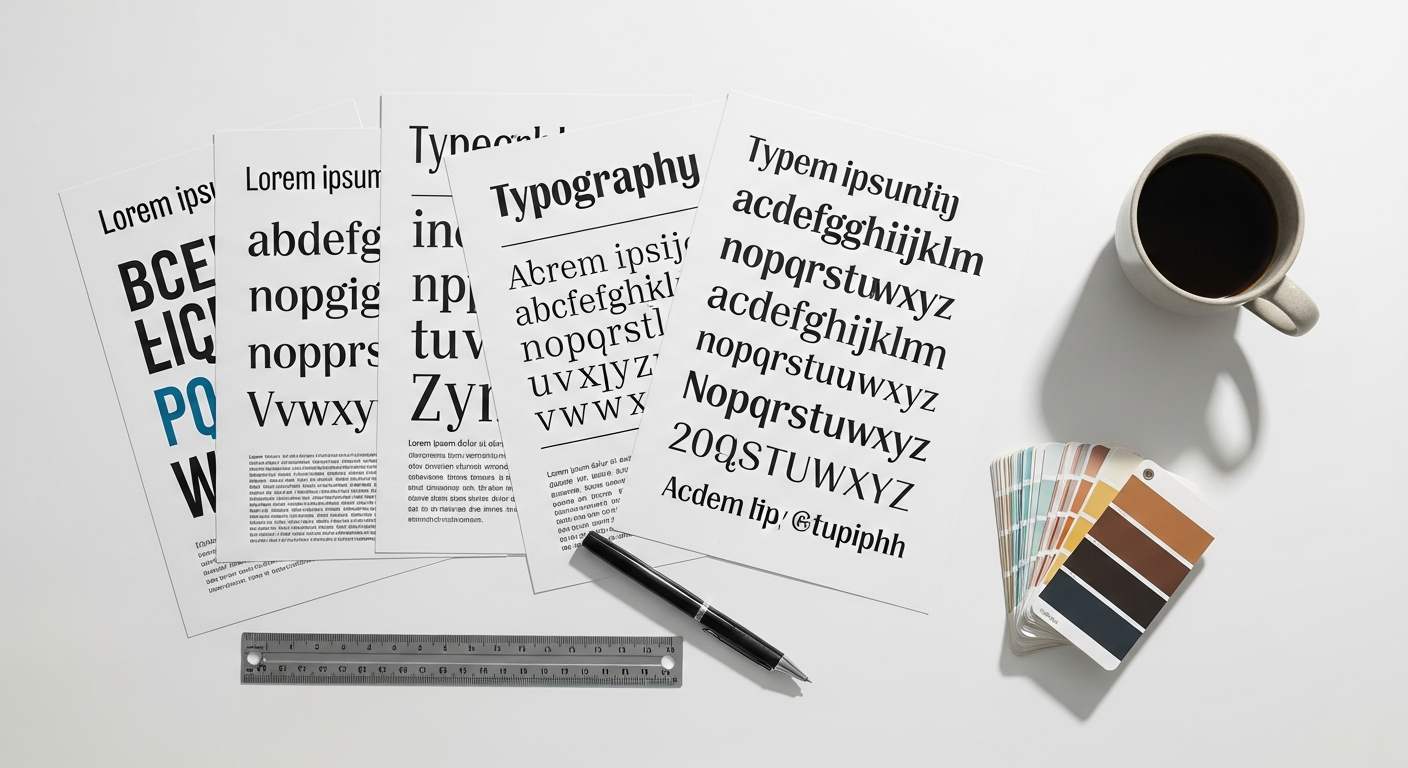
Typography is the art and technique of arranging type to make written language legible, readable, and appealing when displayed. In web design, typography goes beyond merely selecting fonts; it encompasses every aspect of text presentation, from font size and line height to letter spacing and color. As typography expert Oliver Reichenstein famously stated, ‘Web design is 95% typography.’ Excellent typography is fundamental to user experience, as the vast majority of web content is text-based. Poor typography can lead to frustration, reduced engagement, and a diminished perception of professionalism.
The first significant decision in typography is choosing between serif, sans-serif, and display fonts. Serif fonts, characterized by small decorative strokes at the end of letterforms, are often associated with tradition, authority, and readability in long-form print text. Sans-serif fonts, lacking these strokes, are generally perceived as modern, clean, and highly readable on digital screens, making them a popular choice for body text and UI elements. Display fonts are highly decorative and best reserved for headlines or short bursts of text where impact is more important than sustained readability. The judicious pairing of fonts creates visual interest and hierarchy without clashing. Our guide on the Best Fonts for Web Design provides an in-depth look at popular and effective font choices.
Beyond font selection, several micro-typographic considerations are crucial. Line height (leading) significantly impacts readability; too tight, and lines merge; too loose, and text appears disjointed. A general rule of thumb for body text is 1.5 times the font size for optimal readability. Letter spacing (kerning and tracking) adjusts the space between individual characters and words. Font size must be carefully chosen, not just for legibility on desktop, but also for responsiveness on smaller screens. Using relative units like em, rem, or vw allows type to scale appropriately across devices. Accessibility in typography is paramount. High contrast between text and background colors is a WCAG requirement, ensuring readability for users with visual impairments.
The Science of CSS Layouts: Grid vs. Flexbox

The evolution of CSS layout has dramatically transformed how web designers and developers structure web pages, moving from rudimentary methods like floats and positioning to sophisticated, powerful modules like Flexbox and CSS Grid. Understanding when and how to use each of these modern layout techniques is crucial for building responsive, maintainable, and robust user interfaces in 2026. Both Flexbox and CSS Grid are essential tools, but they solve different problems and excel in different scenarios.
Flexbox (Flexible Box Layout Module) is designed for one-dimensional layouts. This means it excels at arranging items in a single row or a single column. Think of it as a tool for distributing space among items along a primary axis and aligning them along a secondary, perpendicular axis. Flexbox is perfect for components like navigation bars, form elements, card lists, or any scenario where you need to align items dynamically within a container. Key Flexbox properties like justify-content allow you to distribute space between items along the main axis, while align-items controls their alignment along the cross-axis.
CSS Grid Layout, on the other hand, is built for two-dimensional layouts. This makes it the ideal solution for laying out entire pages or complex sections that require both rows and columns to be managed simultaneously. With Grid, you define explicit rows and columns using properties like grid-template-columns and grid-template-rows. Modern CSS also introduces powerful functions like clamp() for fluid typography and sizing, minmax() for flexible grid tracks, and the aspect-ratio property for maintaining consistent media proportions. For a deep dive into the nuances and practical applications of these powerful layout modules, our comprehensive CSS Grid vs Flexbox Guide provides detailed examples and best practices.
While often presented as alternatives, Flexbox and CSS Grid are complementary. A common and highly effective strategy is to use CSS Grid for the overall page structure (the macro layout) and then use Flexbox within individual grid cells for arranging content (the micro layout). This combined approach leverages the strengths of both, leading to highly flexible, responsive, and maintainable web designs.
Categories of UI/UX Design Tools and Their Ecosystems
The landscape of UI/UX design tools has undergone a significant transformation in recent years, moving towards more collaborative, cloud-based, and feature-rich platforms. While many tools exist, Figma and Adobe XD have emerged as dominant players, each offering unique strengths for designers in 2026. Understanding their capabilities, and those of other notable tools, is crucial for optimizing workflows and producing high-quality designs efficiently.
Figma has rapidly become a favorite among design teams due to its unparalleled real-time collaboration features. Being entirely browser-based, it eliminates the need for software installations and allows multiple designers to work on the same file simultaneously, seeing each other’s changes live. This fosters an incredibly efficient and transparent design process, making it ideal for distributed teams and agile methodologies. Figma excels in UI design, offering robust vector editing capabilities, sophisticated prototyping tools with interactive flows, and a powerful component system (variants, auto layout) that facilitates the creation and maintenance of design systems.
Adobe XD, part of the Adobe Creative Cloud suite, offers a strong alternative, particularly for designers already integrated into the Adobe ecosystem. XD provides a comprehensive set of tools for wireframing, UI design, prototyping, and collaboration. Its strengths lie in its intuitive interface, seamless integration with other Adobe products like Photoshop and Illustrator, and powerful prototyping features including voice prototyping and auto-animate. For a detailed breakdown of their features, strengths, and weaknesses, our in-depth Figma vs Adobe XD Comparison offers a valuable resource for making an informed choice.
Beyond these two giants, other tools continue to play important roles. Sketch, a Mac-only application, was a pioneer in modern UI design and remains popular, especially for individual designers or smaller teams who prefer a desktop-first approach. InVision Studio aims to be an all-in-one design and prototyping solution, while Axure RP remains the go-to choice for highly complex interactive prototypes and detailed documentation, often favored by UX specialists for enterprise-level projects.
What Makes a Design System Truly Scalable?
In the complex world of web design, consistency and efficiency are paramount, especially as projects grow in size and involve multiple teams. This is where a design system becomes an indispensable asset. A design system is more than just a style guide or a component library; it is a comprehensive collection of reusable components, guided by clear standards and principles, that can be assembled together to build any number of applications. It acts as a single source of truth for design and development, ensuring uniformity, speeding up workflows, and fostering collaboration across an organization.
The benefits of implementing a design system are manifold. Firstly, it drastically improves consistency across all touchpoints. By using predefined components and adhering to established guidelines, users encounter a cohesive experience regardless of which part of your product they are interacting with. Secondly, it drives immense efficiency. Designers no longer need to design common elements from scratch, and developers can reuse existing code components. Thirdly, design systems promote scalability. As products grow and new features are added, the system provides a robust framework to expand upon. A prime real-world example is Spotify’s Encore design system, which allows their disparate teams to maintain a unified aesthetic across mobile apps, desktop clients, and web players while scaling rapidly.
Key components of a robust design system typically include: Design Principles, Brand Guidelines, Visual Style Guide, UI Component Library, and Documentation. Creating a design system is an iterative process that often starts with an audit of existing UI elements, identifying common patterns, and then standardizing them. Tools like Figma and Adobe XD are excellent for building and managing component libraries within a design system, allowing for the creation of master components and instances that update globally. For practical guidance on establishing such a framework, our guide How to Build a Design System offers actionable steps and best practices.
The Principles of Inclusive Web Accessibility
Web accessibility is not merely a technical checkbox; it is a fundamental ethical imperative and a cornerstone of truly inclusive web design. Designing for accessibility means ensuring that websites and web tools can be used by everyone, regardless of their abilities or disabilities. This includes people with visual impairments, hearing impairments, motor impairments, cognitive disabilities, and situational disabilities. Ignoring accessibility excludes a significant portion of the global population and can also lead to legal repercussions, as many countries have laws mandating accessible digital content.
The primary standard for web accessibility is the Web Content Accessibility Guidelines (WCAG), developed by the World Wide Web Consortium (W3C). WCAG 2.1 and the more recent WCAG 2.2 provide a detailed set of recommendations organized around four core principles, often remembered by the acronym POUR: Perceivable (information and UI components must be presentable to users in ways they can perceive), Operable (UI components and navigation must be operable), Understandable (information and the operation of the user interface must be understandable), and Robust (content must be robust enough that it can be interpreted reliably by a wide variety of user agents, including assistive technologies).
Practically, implementing accessibility involves several key considerations. For visual content, providing meaningful alternative text (alt attributes) for images is crucial for screen reader users. Ensuring sufficient color contrast for text and interactive elements makes content readable for those with low vision or color blindness. For operability, all interactive elements must be keyboard-navigable, meaning users who cannot use a mouse can still access and operate every feature using only a keyboard or other assistive devices. Semantic HTML is vital; using appropriate HTML tags provides structure and meaning that assistive technologies can interpret. For a deeper dive into the specific techniques and best practices for creating truly inclusive digital products, our guide Accessibility in UI Design provides comprehensive insights.
The Role of Headless CMS in Modern Design Workflows
As web architecture evolves, the adoption of a Headless Content Management System (CMS) has fundamentally shifted how designers and developers collaborate. Unlike traditional monolithic platforms like standard WordPress, a headless CMS (such as Sanity, Contentful, or Strapi) decouples the backend content repository from the frontend presentation layer. The content is delivered via APIs (like REST or GraphQL) to any device or platform, giving design teams unprecedented creative freedom.
For UI/UX designers, this separation of concerns is a game-changer. You are no longer constrained by rigid, pre-defined templates or the technical limitations of a specific backend framework. Instead, designers can craft bespoke, highly interactive frontend experiences using modern JavaScript frameworks like React, Vue, or Svelte, knowing the content will seamlessly flow into the designated components. This architecture perfectly complements the use of scalable design systems, as content models can be mapped directly to UI components in tools like Figma.
Furthermore, a headless CMS empowers omnichannel design. Because the content is platform-agnostic, the same backend data can populate a web application, a native mobile app, a smartwatch interface, or even an AR/VR environment. This ensures brand consistency across all touchpoints while allowing designers to optimize the user interface specifically for the context of each device. Embracing headless architecture is rapidly becoming a critical competency for design teams aiming to build fast, scalable, and future-proof digital products.
What Is the Future of Web Design and How Should You Prepare?
Navigating the dynamic world of web design and visual design in 2026 demands a blend of foundational knowledge, continuous learning, and a user-centric mindset. Looking beyond current trends, the future of web design is heavily intertwined with emerging technologies. Artificial Intelligence (AI) is already streamlining workflows through generative design tools, automated layout adjustments, and personalized user experiences. We are also seeing a shift towards spatial computing, where VR/AR interfaces demand new interaction paradigms beyond the traditional 2D screen. Advanced motion design, powered by WebGL and optimized CSS animations, will continue to add depth and micro-interactions without compromising performance.
Key Takeaways
- User-Centricity is Paramount: Always design with the end-user in mind, focusing on their needs, behaviors, and accessibility requirements.
- Visual Design Fundamentals are Crucial: Master color theory, typography, and layout principles to create aesthetically pleasing and highly functional interfaces.
- Modern CSS Layouts are Essential: Leverage Flexbox for 1D component layouts and CSS Grid for 2D page structures to build responsive and robust designs.
- Choose the Right Tools for Your Workflow: Familiarize yourself with leading design tools like Figma and Adobe XD, understanding their strengths for collaboration and prototyping.
- Accessibility is Not Optional: Adhere to WCAG guidelines (2.1/2.2) and design inclusively to ensure your websites are usable by everyone, regardless of ability.
Comparison of Key Design Concepts & Tools
| Concept/Tool | Purpose | Key Features/Use Cases | Primary Benefit |
|---|---|---|---|
| Flexbox | 1D Layout (single row/column) | Aligning items in navbars, distributing space in cards, centering elements. | Efficient alignment and distribution of items within a single dimension. |
| CSS Grid | 2D Layout (rows and columns) | Full page layouts, complex content sections, magazine-style designs. | Powerful control over entire page structures with explicit rows and columns. |
| Figma | UI Design & Prototyping | Real-time collaboration, robust prototyping, auto layout, component variants. | Seamless team collaboration and efficient design system management. |
| Adobe XD | UI/UX Design & Prototyping | Intuitive interface, Adobe CC integration, advanced animation, voice prototyping. | Strong integration with Adobe ecosystem and powerful prototyping capabilities. |
| WCAG 2.1/2.2 | Web Accessibility Guidelines | Contrast ratios, keyboard navigation, semantic HTML, alternative text. | Ensures websites are usable by people with disabilities, promoting inclusivity. |
| Design Systems | Standardization & Scalability | Reusable components, style guides, documentation, design principles. | Consistency, efficiency, and scalability across digital products. |
Frequently Asked Questions (FAQ)
What is the most important skill for a web designer in 2026?
While technical skills are crucial, the most important skill for a web designer in 2026 is a strong understanding of user experience (UX) principles coupled with a commitment to accessibility. The ability to empathize with users, conduct research, solve problems, and design inclusive interfaces that cater to diverse needs far outweighs mastery of any single tool or coding language.
How can I stay updated with the latest web design trends and technologies?
Staying current in web design requires continuous learning. Regularly read industry blogs, subscribe to newsletters from leading design organizations, follow influential designers on social media, participate in online communities, and attend virtual workshops or conferences. Experimenting with new tools and techniques on personal projects is also an excellent way to gain practical experience.
Is coding knowledge necessary for UI/UX designers?
While you do not necessarily need to be a full-stack developer, a foundational understanding of HTML, CSS, and basic JavaScript is highly beneficial for UI/UX designers. Knowing how your designs translate into code helps you create more feasible and efficient designs, fosters better communication with developers, and gives you a deeper appreciation for technical constraints and possibilities.
What is the difference between UI design and UX design?
UI (User Interface) design focuses on the visual and interactive elements of a product – what the user sees and interacts with. This includes layouts, color palettes, typography, buttons, and animations. UX (User Experience) design encompasses the entire journey a user takes when interacting with a product. It is about how a user feels about the product and includes aspects like usability, accessibility, information architecture, and user research.
How important is mobile-first design in 2026?
Mobile-first design is critically important in 2026 and will continue to be so. With mobile devices often being the primary means of accessing the internet for a vast number of users, designing for the smallest screen first ensures that the core content and functionality are prioritized. This approach forces designers to make smart decisions about content hierarchy, performance, and interaction patterns.
Sources & References
- Nielsen Norman Group. “10 Usability Heuristics for User Interface Design.” NN/g Articles.
- World Wide Web Consortium (W3C). “Web Content Accessibility Guidelines (WCAG) 2.2.” W3C Recommendations.
- MDN Web Docs. “CSS Grid Layout.” Mozilla Developer Network.
- Reichenstein, Oliver. “Web Design is 95% Typography.” Information Architects (iA).
Reviewed by Maya Singh, Senior Content Editor & UX Strategist — Last reviewed: April 15, 2026